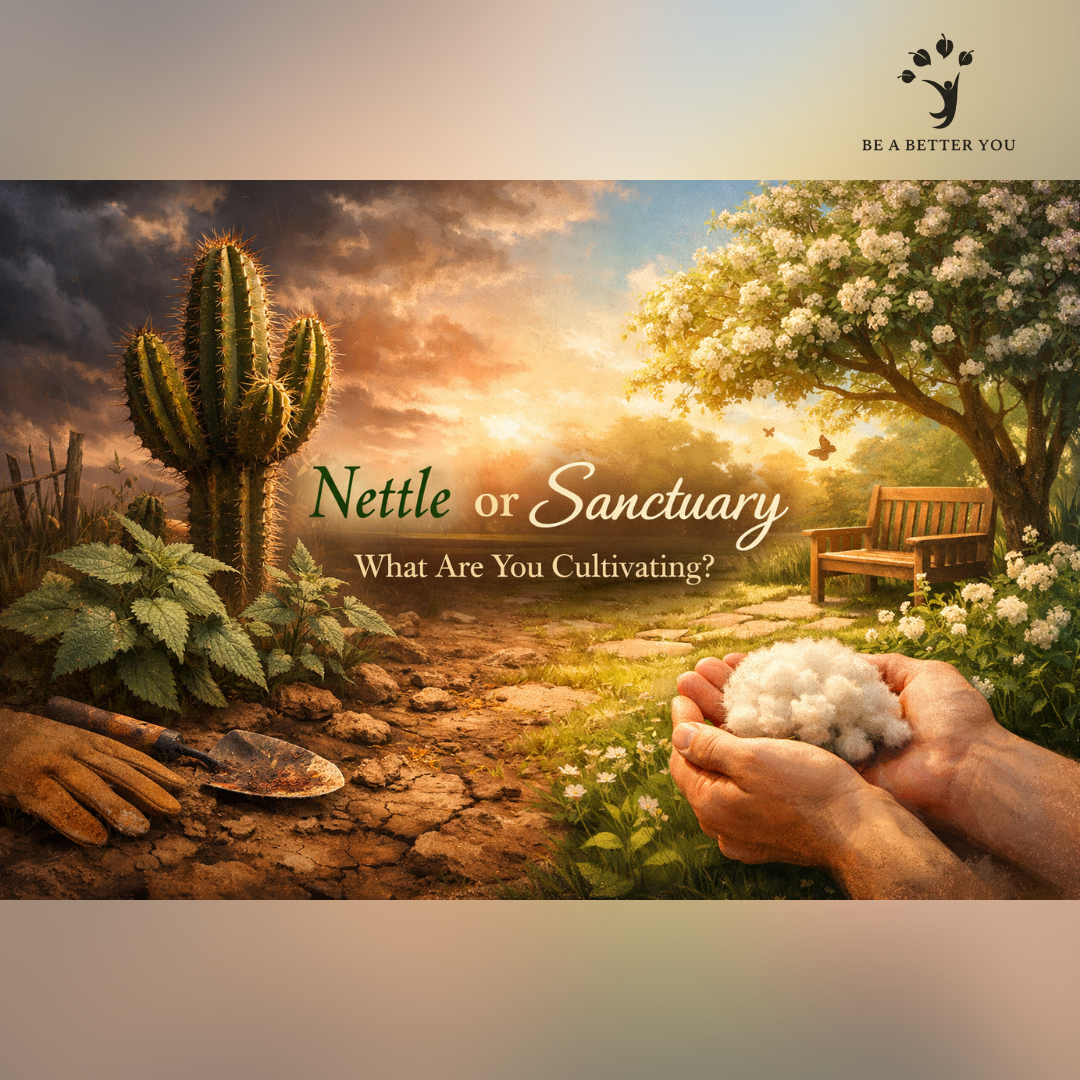
Imagine you have two people in your life. And you see them planting something in the same garden. After taking care of the plant, they gift it to you. When you discover the gifts, you find that the two are completely opposite. One plant hurts you with its spikes, but the other plant makes you feel like cotton.
So which will you prefer in future? Mostly, the cotton one, but it also depends on the person's choice. For some people, the spiky plant feels necessary. Or maybe the same plant feels different for different people based on their character, behaviour, or patterns.
Similarly, relations are like a garden. What you plant will grow more. But do you know that consciously or unconsciously, we are planting and nurturing one or the other plant? And as a result, some people or relations grow as spikes called Nettle, and others grow as cotton called Sanctuary.
So the question is not who you are? The question is: What are you cultivating? Hum kar roz kuch na kuch uga rahe hain... par kya?
Let’s understand the Nettle personality. The person who is quick to react, easily offended, defensive in conversations, has a critical tone, is emotionally unavailable, uses silence or anger for control, creates tension in rooms for others or has harsh inner dialogue, engages in guilt-driven actions, overthinks constantly, lives in survival mode, falls into this category.
But here is also a tricky part. What do you think about why they behave like this? The first answer that I get is because they are like this. That is their behaviour. But when I ask them, they generally go blank, start thinking, or say, "I don’t know."
While researching and studying patterns, I came up with something I am sharing with you.
Three common reasons can be the root cause of why people become nettled.
A. Childhood Emotional Environment - People who grew up with criticism, emotional neglect, conditional love, unpredictable parenting, and no emotional validation often develop protective patterns that feel like nettles.
B. Trauma & Painful Incidents – In the book Your Body Keeps the Score, I read that people who face betrayal, abandonment, public humiliation, emotional rejection or any incident that is traumatic for them make them nervous.
C. Learned Behaviour – Sometimes, because of family, they modelled parents’ reactions, saw anger used as power, and never learned that healthy conflict becomes nettlesome.
So the end result of this situation is that the person becomes someone who annoys, irritates, and provokes other people, creating emotional distance in the relationship. People around them often walk on eggshells. They have conflict escalation, loneliness despite being surrounded by people, inner restlessness, anxiety or emotional heaviness. They often have protection mechanisms. It is their survival pattern, not a personality flaw. Because many sharp adults were once unprotected children.
But here the important question arises. Can a nettle become a sanctuary?
Yes. Absolutely. But major transformation often begins after a painful breakup, becoming a parent, burnout, losing someone, therapy or deep self-reflection, a moment of realisation: “I don’t want to be this way or when pain becomes awareness.
Before moving on to transformation, let's understand what a Sanctuary Personality is.
People who fall in this category are generally the person who listens without interrupting, respond instead of reacting, set boundaries calmly, have an emotionally safe presence, accept differences, and regulate before speaking. Inside themselves, they are gentle self-talk, emotional awareness, pausing before reacting, and choosing clarity over control.
Sanctuary sounds like: “I’m here.” “Tell me more.” “It’s okay to feel this.”
To shift from nettle to sanctuary, you have to notice your triggers, pause before responding, and reflect: “What am I protecting?” Learn emotional regulation, do journaling about recurring patterns, take accountability, and choose softness without losing strength.
An important point to remember is that change is intentional. You cannot accidentally grow as a sanctuary.
Reflective Questions for you –
- When do I become sharp?
- Who taught me this pattern?
- What fear sits underneath my reactions?
- Do people feel relaxed around me?
- Do I feel relaxed around myself?
- What kind of emotional garden do I want to grow?
If this made you reflect on your patterns and you want to explore them more deeply, connect with me. Together, we will address your questions and concerns.
If this article resonated with you, you'll find practical exercises and a complete framework in my book Mind Dump Method: Stop Overthinking in 10 Minutes a Day. Click Books in the menu to learn more.
Remember
Every word is a seed. Every reaction is water. Every day, you are cultivating something. The choice is ongoing. Sometimes we step on our own nettles before we decide to grow something softer.